A student spends three hours grinding through Lagrangian mechanics problems, fills half a notebook with wrong turns, and finally arrives at the correct answer. Another student types the same problem into an AI solver and reads a clean, step-by-step solution in forty seconds. Both now possess the same information. But behavioral economics predicts they will not value it equally – and that prediction has measurable consequences for how each student performs on exam day.
This asymmetry sits at the intersection of two fields rarely discussed together: behavioral economics and physics education technology. The effort heuristic – a cognitive bias first formalized by Kruger, Wirtz, Van Boven, and Altermatt in 2004 – describes people’s tendency to judge quality and value by perceived effort. In education, this bias shapes not only how students feel about their knowledge but how deeply they encode it, how persistently they apply it, and how easily they abandon a subject when difficulty spikes.
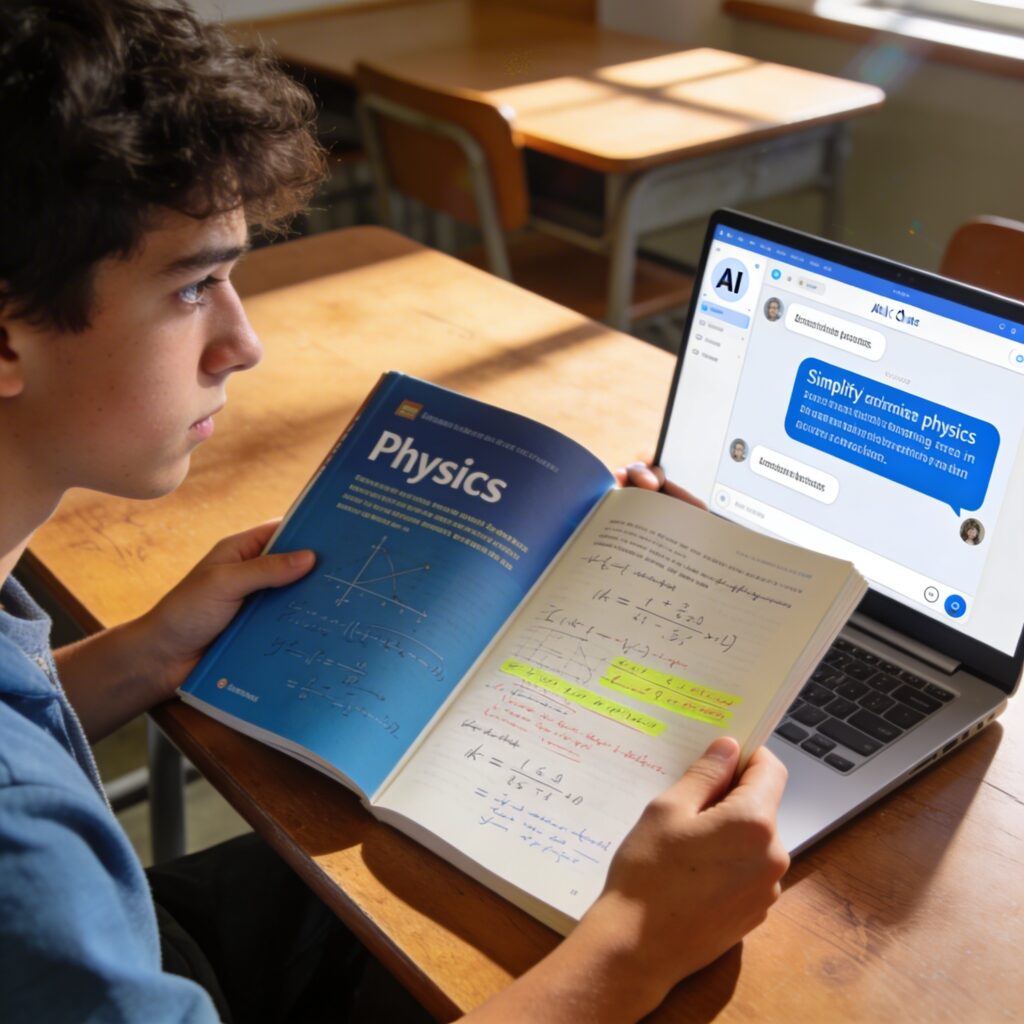
The rapid adoption of AI-powered homework tools has made this bias acutely relevant. Platforms like ai physics solver deliver instant, structured solutions to problems that once required hours of unguided struggle. The pedagogical question is no longer whether students will use these tools – adoption is already widespread – but whether the perceived ease they introduce undermines the subjective value students assign to physics competence, and whether that devaluation translates into weaker long-term learning outcomes.
What Is the Effort Heuristic and Why Does It Matter in Education?
The effort heuristic is a cognitive bias in which people assign greater value to outcomes that required more effort to produce. A painting believed to have taken four years commands more respect than one completed in a week, independent of aesthetic quality. Kruger et al. demonstrated this across multiple domains: poems, paintings, and even body armor were rated higher when participants believed more labor went into them.
In education, the heuristic operates on self-directed judgments. A student who struggled through a derivation rates their understanding as more valuable and more durable than a student who received the same derivation pre-solved. This is not purely irrational – effort often does correlate with deeper processing. But the bias persists even when the effortless path produces equivalent or superior comprehension, which is precisely the scenario AI tools create.
How Is the Effort Heuristic Different From the IKEA Effect and Desirable Difficulty?
The IKEA effect, documented by Norton, Mochon, and Ariely in 2012, describes inflated valuation of things people partially created themselves. Desirable difficulty, a concept from Robert Bjork’s memory research, refers to encoding conditions that feel harder during learning but produce stronger long-term retention – spaced repetition, interleaving, and retrieval practice being the canonical examples.
The effort heuristic is distinct from both. The IKEA effect requires personal labor investment and operates on ownership pride. Desirable difficulty is a property of the learning process itself – it describes when struggle actually improves memory consolidation at a neural level. The effort heuristic, by contrast, is purely perceptual: it is the assumption that hard-won knowledge must be more valuable, regardless of whether the difficulty was pedagogically productive. A student who spent two hours confused by a poorly written textbook experienced difficulty, but not desirable difficulty. The effort heuristic would still inflate their perceived value of whatever they retained.
This distinction matters because AI tools eliminate both productive and unproductive friction simultaneously. A well-designed AI tutor removes the unproductive kind (hunting for formulas, deciphering notation) while preserving the productive kind (requiring the student to predict next steps, explain reasoning). A poorly designed one removes both, leaving the student with correct answers and an illusion of competence.
What Does Cognitive Ease Do to a Student’s Confidence in Their Own Knowledge?
When information is processed fluently – read in clear fonts, delivered in a logical sequence, presented without friction – people systematically overestimate how well they have learned it. Psychologists call this the fluency effect; in educational contexts, it manifests as the illusion of competence. Karpicke and Blunt’s 2011 study in Science demonstrated that students who simply reread material rated their knowledge nearly as high as students who practiced retrieval, but performed significantly worse on delayed tests.
AI solvers amplify this effect. A physics student who reads a perfectly formatted, logically sequenced AI-generated solution to a rotational dynamics problem experiences high cognitive fluency. Every step follows the last; no confusion arises. The student feels they understand. But feeling and understanding are neurologically different events. Understanding requires effortful encoding – the generation effect shows that information a learner produces (even incorrectly at first) is retained far better than information they passively receive.
The risk is not that AI solutions are wrong. The risk is that they are too right, too cleanly, too fast – producing a subjective experience of mastery that does not correspond to durable memory traces.
Do AI Physics Solvers Actually Help Students Learn, or Just Solve Problems?

The answer depends entirely on tool architecture and student behavior. An AI system that accepts a problem and returns a final numerical answer functions as a shortcut. An AI system that decomposes the problem into sub-steps, asks the student to attempt each step before revealing guidance, and provides explanations tied to underlying principles functions as a tutor. The pedagogical difference between these two designs is the difference between giving someone a fish and teaching them to fish – except the student cannot always tell which one is happening.
What Is the Difference Between an AI Solver and an AI Tutor?
The distinction is structural, not cosmetic. Intelligent tutoring systems (ITS) research, dating back to Carnegie Learning’s Cognitive Tutor in the 1990s, established that adaptive scaffolding produces learning gains comparable to human one-on-one tutoring – roughly two standard deviations above traditional lecture, per Bloom’s 1984 findings on the “2 sigma problem.”
| Dimension | AI Solver | AI Tutor |
| Primary output | Final answer or complete solution | Step-by-step guided reasoning |
| Student role | Passive reader | Active participant at each step |
| Cognitive process triggered | Recognition and review | Retrieval, generation, error correction |
| Effort heuristic effect | Devaluation – knowledge feels “given” | Preservation – knowledge feels “earned” |
| Typical problem flow | Input → full solution | Conceptual setup → free-body diagram → equation selection → algebraic manipulation → numerical result, with student engagement at each stage |
| Predicted exam transfer | Weak – low generative encoding | Strong – high generative encoding |
Modern AI physics tools vary widely along this spectrum. The scaffolded approach preserves the generative processing that the effort heuristic tells us students instinctively value and that memory research confirms they need.
Can Students Use AI Homework Help Without Falling Into the Fluency Trap?
Yes, with deliberate protocol. Cognitive science supports a “generate-then-verify” cycle that preserves retrieval practice while leveraging AI feedback:
- Attempt the problem independently. Write out your reasoning in full, including dead ends and points of confusion.
- Document where you get stuck. Articulate the specific step or concept blocking progress – this self-explanation act alone strengthens encoding.
- Compare your approach against the AI solution. Focus on reasoning divergences, not just whether the final answer matches.
- Redo a similar problem unaided. This final retrieval attempt consolidates the corrected understanding into long-term memory.
This sequence preserves the error-correction loop that drives retention while still providing the feedback that AI tools offer.
The critical behavioral variable is when the student accesses the AI. Using it before attempting the problem turns the tool into a crutch. Using it after a genuine attempt turns it into feedback – and feedback is one of the most robust predictors of learning gain in educational research, as confirmed by Hattie’s meta-analyses showing an average effect size of 0.73 for feedback interventions.
Why Do Students Choose the Easiest Path – and Is That Always Wrong?
Present bias – the tendency to overweight immediate rewards relative to future ones – predicts that students will consistently choose lower-effort study strategies even when they know harder strategies produce better outcomes. This is not laziness; it is a well-documented feature of human temporal discounting. Students are not irrational for preferring AI-assisted problem solving. They are behaving exactly as behavioral economics predicts any agent with hyperbolic discount functions would behave.
The policy question is not how to override this preference through willpower appeals or tool bans. The question is how to design learning environments where the low-friction path also happens to be the pedagogically effective one – an application of Thaler and Sunstein’s choice architecture framework to educational technology.
What Does Behavioral Economics Tell Us About Homework Procrastination in STEM?
Procrastination in physics courses follows a predictable pattern: high perceived effort combined with distant rewards (exam performance, degree completion, career outcomes) and immediate alternatives (social media, entertainment) creates a consistent bias toward delay. Steel’s 2007 meta-analysis of procrastination research found that task aversiveness and delayed reward were the two strongest predictors of procrastination across 216 studies.
AI solvers alter this equation at the entry point. The psychological barrier to starting a physics problem set is often higher than the barrier to completing it – students describe the blank-page moment as the hardest part. A tool that helps structure the first step, identify the relevant principle, or recall the applicable equation reduces the activation energy for task initiation. If the tool then progressively withdraws support (a technique called fading in scaffolding research), the student transitions from AI-assisted to independent work within the same session.
Is Removing Struggle From Physics Homework the Same as Removing Learning?
No, and conflating the two is a category error. Bjork’s desirable difficulty framework specifies which types of struggle benefit retention: effortful retrieval (recalling information from memory rather than re-reading it), spaced practice (distributing study over time), and interleaving (mixing problem types rather than blocking them). These are the productive difficulties.
Unproductive difficulty – frustration from unclear problem statements, missing prerequisite knowledge, inability to locate relevant formulas, or poorly structured textbooks – does not enhance learning. It increases cognitive load without increasing encoding depth. Sweller’s cognitive load theory distinguishes between intrinsic load (inherent to the material’s complexity), germane load (effort directed at schema construction), and extraneous load (effort wasted on poor instructional design). AI tools that reduce extraneous load while preserving germane load are doing exactly what good pedagogy prescribes.
The effort heuristic, however, does not distinguish between productive and unproductive struggle. A student who suffered through extraneous difficulty will still feel their knowledge is more “earned.” This perceptual bias should not guide educational policy.
Does Easy Access to Answers Make Physics Knowledge Feel Worthless?
The effort heuristic predicts that when knowledge acquisition feels effortless, students assign it lower subjective value. This devaluation can trigger a downstream behavioral cascade: reduced motivation to retain the knowledge, lower willingness to apply it in novel contexts, and diminished identification as “someone who knows physics.” The bias operates at the identity level, not just the information level.
Survey data from STEM programs consistently shows that students who describe their courses as “hard” also describe their degrees as more valuable, even controlling for actual learning outcomes. This is the effort heuristic operating at scale – institutional difficulty is treated as a quality signal by students, employers, and faculty alike.
Will Employers and Professors Devalue AI-Assisted Learning?
Early evidence is mixed but directional. A 2023 survey by the National Association of Colleges and Employers found that 45% of hiring managers expressed concern about candidates who relied heavily on AI tools during their education. This concern mirrors the effort heuristic: the managers are using perceived effort as a proxy for competence.
The counter-trend is skills-based hiring, which evaluates demonstrated ability regardless of how it was acquired. In physics-adjacent industries – engineering, data science, quantitative finance – the hiring standard is increasingly what a candidate can do on a timed technical assessment, not how they studied. This trend suggests the effort heuristic may be more persistent in academic settings (where process is valued) than in industry (where output is valued).
Is the “AI Devalues Education” Panic Just the Calculator Debate Again?
The structural parallel is strong. When handheld calculators entered classrooms in the 1970s, mathematics educators argued that students would lose arithmetic fluency and conceptual understanding. When Wolfram Alpha launched in 2009, the same argument resurfaced for symbolic computation. In both cases, pedagogy adapted: curricula shifted toward higher-order problem formulation and interpretation, and the tool became a baseline expectation rather than a threat.
The AI case differs in one respect: calculators automated computation, while AI tools can automate reasoning – explaining why a particular approach works, not just executing it. This means the adaptation required from educators is more fundamental. The boundary between “what the tool does” and “what the student must do” has moved further up Bloom’s taxonomy, from application and analysis toward evaluation and synthesis.
What Does the Research Say: AI-Assisted vs. Traditional Learning Outcomes in Physics?
The empirical literature on AI-assisted physics learning is still maturing, but several consistent patterns have emerged from studies conducted between 2020 and 2025. Students who use AI tools for homework show comparable or slightly improved performance on conceptual inventories like the Force Concept Inventory (FCI), but weaker performance on novel transfer problems – questions requiring application of principles to unfamiliar scenarios. This pattern aligns with the predicted effect of reduced generative processing: recognition and recall are preserved, but flexible application is not.
Do Students Who Use AI Solvers Score Lower on Exams?
A homework-exam performance gap has been documented in multiple course contexts. Students whose homework scores are significantly higher than their exam scores are statistically more likely to be using external solution tools – a pattern that predated AI and was previously associated with solution manual use. The gap itself is not diagnostic (some students simply perform worse under time pressure), but when it correlates with tool access, it suggests that the homework did not produce the encoding necessary for unsupported recall.
The variable that moderates this gap is usage pattern. Students who use AI tools generatively – attempting problems first, then comparing their reasoning to the AI solution – show no significant homework-exam gap. Students who use AI tools passively – reading solutions without prior attempt – show the largest gaps. This finding has been replicated across introductory mechanics, electromagnetism, and thermodynamics courses.
How Should We Measure “Real Learning” in the Age of AI?
Traditional metrics – homework completion rates, problem set scores – lose diagnostic value when AI tools can produce correct answers independent of student understanding. More reliable indicators include:
- Transfer tasks – novel problems requiring application of principles in unfamiliar contexts, where memorized solution templates fail.
- Explanation quality – asking students to teach a concept back in their own words, which directly tests generative encoding and exposes illusions of competence.
- Delayed retrieval assessments – testing the same material two to four weeks later without prior notice, measuring durable memory traces rather than short-term recognition.
These metrics are more expensive to administer than automated homework grading, which creates a resource tension: the same AI tools that necessitate better assessment also make the cheapest form of assessment unreliable. Institutions that fail to upgrade their measurement approaches will be unable to distinguish between students who learned and students who outsourced.
How Should Educators Integrate AI Tools Without Sacrificing Rigor?
The most effective integration model is structured permission with metacognitive framing. Rather than banning AI tools or permitting them unconditionally, high-performing physics programs are specifying which tasks permit AI use, which prohibit it, and – critically – requiring students to articulate why the distinction exists. This metacognitive layer forces students to confront the effort heuristic directly: they must consider when ease helps and when it hinders.
What Does a Good University AI Policy for Physics Courses Look Like?
Effective policies share three structural features:
- Task-specific permissions. AI may be permitted for practice problems and exploratory learning while prohibited for graded assessments and lab reports. Blanket bans ignore the nuance; blanket permission ignores the risk.
- Transparent disclosure frameworks. Students are asked to report AI usage and describe how they used it – normalizing the tool while maintaining accountability and generating data on usage patterns.
- Metacognitive education. The policy explains why it exists, connecting restrictions to memory research, the effort heuristic, and the homework-exam gap, so that compliance is motivated by understanding rather than fear of punishment.
The University of Michigan’s physics department piloted such a policy in 2024, allowing AI tool use on weekly problem sets while requiring handwritten, AI-free solutions on midterms. The department reported no significant change in homework completion rates and a narrowing of the homework-exam gap, suggesting students internalized the distinction between practice and assessment.
Can AI Itself Be Designed as a Behavioral Nudge Toward Deeper Learning?
AI tools can function as choice architecture within the learning environment. Default settings matter: a tool that defaults to showing hints before full solutions nudges students toward generative processing. A tool that requires the student to type their current approach before unlocking the AI solution introduces a commitment device – a concept from behavioral economics where an agent restricts their future choices to align with long-term goals.
Scaffolded AI physics tools already implement several nudge principles. Progressive disclosure (revealing solution steps one at a time) preserves retrieval opportunities. Friction injection (requiring a brief self-explanation before proceeding) increases germane cognitive load. Adaptive difficulty (adjusting problem complexity based on demonstrated mastery) maintains challenge at the optimal level identified by Vygotsky’s zone of proximal development and flow theory.
These design choices transform the AI tool from a threat to the effort heuristic into a calibration instrument for it. The student still experiences productive difficulty, still engages in generative processing, and still encodes knowledge through active retrieval – but without the unproductive friction that drives procrastination and dropout. The effort feels real because it is real; the AI simply ensures it is directed at the right cognitive targets.
The behavioral economics framing offers a final insight: the goal is not to make physics hard or easy but to make the productive difficulty feel accessible and the unproductive difficulty disappear. When AI tools achieve that calibration, the effort heuristic works in the student’s favor – they value their knowledge because they genuinely worked for it, even if an AI helped them work smarter.